
High Value Home Insurance Group: Specialized high value home insurance for the ranches, vineyards, and Hill Country estates of Dripping Springs, where large acreage meets Central Texas’s most flood- and fire-prone terrain.
Uncompromising coverage. Unwavering peace of mind.
Placed With Industry-Leading Carriers
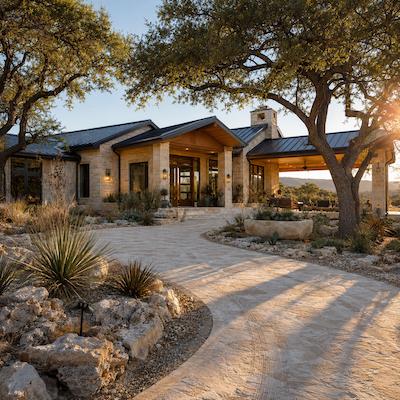
Dripping Springs has grown from a rural crossroads into one of Central Texas’s most sought-after luxury addresses, and the homes reflect it. In communities like Caliterra, Headwaters, Belterra, and Deer Creek Ranch, custom stone-and-metal Hill Country architecture sits on lots ranging from a half acre to multi-acre ranchettes, while properties along Saddletree Ranch and the surrounding countryside push into true acreage estates with barns, guest houses, and private wells. A standard homeowners policy, priced for a production-built subdivision house, was never built to underwrite this scale.
The risk profile here is distinct from anywhere else HVHIG serves. Dripping Springs sits inside what meteorologists and emergency managers call “Flash Flood Alley,” the crescent of thin-soil, karst-limestone terrain running along the Balcones Escarpment from San Antonio through Austin. Rocky, shallow clay soils shed rainfall instead of absorbing it, so a fast-moving storm can turn a dry Hill Country draw into a torrent within the hour. Onion Creek, which runs near Dripping Springs on its way into Austin, has recorded some of the region’s worst flood crests on record. Add in the area’s heavy ashe juniper (cedar) cover, a fast-burning fuel source across the wildland-urban interface, and severe convective storms bringing large hail, and the combined exposure calls for coverage built specifically around this terrain rather than a generic Austin-suburb template. The National Weather Service’s Austin/San Antonio office covers the flash-flood-alley conditions that give this stretch of Hill Country its name.
HVHIG structures policies around what actually threatens a Dripping Springs property: dwelling coverage rebuilt at true replacement cost, not market value, for the custom materials and outbuildings common on acreage; flood insurance for homes outside the mapped flood zone, since Flash Flood Alley regularly floods property that FEMA maps say is low-risk; and valuable personal property protection for wine collections, art, and equestrian equipment kept on-site. Large-acreage owners with guest structures, ponds, or event space also need liability coverage sized to the property, not the house.
In Flash Flood Alley’s epicenter, the right policy is the one built around the terrain, not around a generic Austin suburb.
Speak with a Dripping Springs high-value home specialist today.
Ready to review your coverage?
A complimentary policy review takes 20 minutes and often reveals significant coverage gaps on Dripping Springs homes.
Dripping Springs sits within the Balcones Escarpment’s “Flash Flood Alley,” where thin, rocky soils over karst limestone shed intense rainfall instead of absorbing it. Onion Creek, which runs near the city, has recorded historic flood crests during sudden storms. Many affected properties sit outside FEMA’s mapped flood zones, which is exactly why standalone flood coverage matters here.
Dense ashe juniper, locally called cedar, blankets much of the Hill Country around Dripping Springs and burns hot and fast. Large-acreage properties bordering undeveloped brush sit squarely in the wildland-urban interface, where local volunteer fire departments issue seasonal burn bans during dry stretches. Defensible space and dwelling coverage that reflects true rebuild cost both matter.
Central Texas sits in a corridor prone to severe convective storms, including damaging hail and straight-line wind events that can affect standing-seam metal roofs, custom stonework, and outbuildings common on Hill Country estates. Storm-driven damage to barns, fencing, and guest structures is a recurring claim category for acreage owners.
The mix of shallow clay and limestone across Hays County expands and contracts with moisture swings between drought and heavy rain, a known source of foundation stress for custom-built homes. While foundation movement itself typically falls outside standard coverage, the resulting water intrusion or structural damage from a covered event needs to be addressed at the policy level.
Large lots with equestrian facilities, ponds, guest houses, and long private driveways carry liability exposure well beyond a standard suburban lot, particularly where properties host weddings or events common to the local wine-country economy. Underinsured liability limits are a frequent gap on acreage estates.
Custom stonework, standing-seam metal roofing, and Hill Country architecture cost more to rebuild than standard estimators assume. HVHIG structures dwelling coverage around actual local rebuild cost, including barns, guest houses, and other outbuildings common on Dripping Springs acreage.
Flash Flood Alley regularly floods land that FEMA maps rate as low-risk. HVHIG arranges flood coverage for homes outside the designated flood zone, closing a gap standard homeowners policies leave wide open near Onion Creek and other Hill Country drainages.
Rebuilding a custom acreage estate after a total loss almost always costs more than the original purchase price reflects. Coverage benchmarked to true replacement cost rather than market value protects against post-loss construction and material cost inflation.
Wine collections, art, firearms, and equestrian tack are common on Dripping Springs estates and often exceed standard personal property sublimits. Scheduled valuable personal property coverage insures these items at appraised value with broader protection.
Ponds, barns, long driveways, and event-friendly acreage raise liability exposure well past a suburban lot. Layering personal liability coverage with an umbrella policy sized to the property protects against a serious injury claim on the premises.
Barns, workshops, guest houses, and private well systems are standard on Dripping Springs acreage but frequently underinsured or excluded by default. HVHIG reviews every structure on the property so coverage and premium reflect the full estate, not just the primary residence.
We protect high-value homes across Dripping Springs and the surrounding Texas area’s most prestigious addresses.
The following is a representative scenario illustrating how we structure coverage; it is not a specific client account.
The following is a composite, illustrative scenario built from the kinds of coverage gaps HVHIG regularly finds on Hill Country acreage. It is not an account of any actual client. A homeowner on a five-acre lot near Onion Creek carried a standard homeowners policy with no separate flood coverage, since the parcel sat outside the FEMA-mapped flood zone. A fast-developing storm sent runoff through the property’s low draw, damaging the home’s foundation-level rooms and a detached guest house, with no flood policy in place to respond.
After the loss, HVHIG rebuilt the coverage around the property’s actual terrain: standalone flood insurance despite the “low-risk” FEMA designation, guaranteed replacement cost dwelling coverage that accounted for the custom guest house, and an umbrella policy sized to reflect the acreage and a small on-site wedding-venue business the family had started renting out. The rebuilt policy now matches what the land and structures actually expose the family to, not what a generic subdivision policy assumed.
Common Dripping Springs High-Value Home Insurance Questions
Dripping Springs sits within the Balcones Escarpment corridor, a band of thin, rocky soil over karst limestone running from San Antonio through Austin that sheds intense rainfall rapidly instead of absorbing it. Combined with Gulf moisture colliding with drier air, this creates some of the fastest-rising flash floods in the country, including on nearby Onion Creek.
Yes. FEMA flood maps in Flash Flood Alley often understate real risk because flooding here is driven by fast, localized runoff rather than mapped floodplain overflow. HVHIG regularly arranges flood coverage for homes outside the designated flood zone for exactly this reason.
Dense ashe juniper cover across Hays County creates a fast-burning fuel load in the wildland-urban interface, which insurers weigh when underwriting acreage properties bordering undeveloped brush. Maintaining defensible space around structures and confirming your dwelling coverage reflects full rebuild cost both matter for wildfire-adjacent properties.
Protect your Dripping Springs home. Request a complimentary, no-obligation quote for your luxury home today.
Connect with our dedicated brokers to discuss referral solutions for your high-net-worth Dripping Springs clients with complex coverage needs.
Dripping Springs’s estates deserve coverage built around how they’re actually constructed, valued, and used, not a generic homeowners policy stretched to fit. Contact High Value Home Insurance Group to structure a policy suited to your Dripping Springs property.